Community Transit

HOME

<i>Swift</i> bus rapid transit

What will you do with the time you save riding Swift?

Bus Rapid Transit

Swift serves a 17-mile route between Everett and Shoreline. This fast, frequent and convenient service offers several features that make Swift Community Transit’s highest ridership route.

  • No need for a schedule - Swift operates every 12 minutes weekdays from 6 a.m. to 7 p.m. and every 20 minutes weekdays from 5-6 a.m., weeknights and on Saturdays. Last bus leaves each terminal at 9:40 p.m. Buses don't run on Sundays or major holidays.
  • Pay fares first – Riders pay their fares at the station while waiting for the bus, then board at any door when the bus arrives. Fares are: adults $1.75, youth $1.25, reduced $0.75.
  • Fast boarding Swift buses have three doors and you can enter at any one. Bicycles can be rolled onto bike racks located inside the back door.
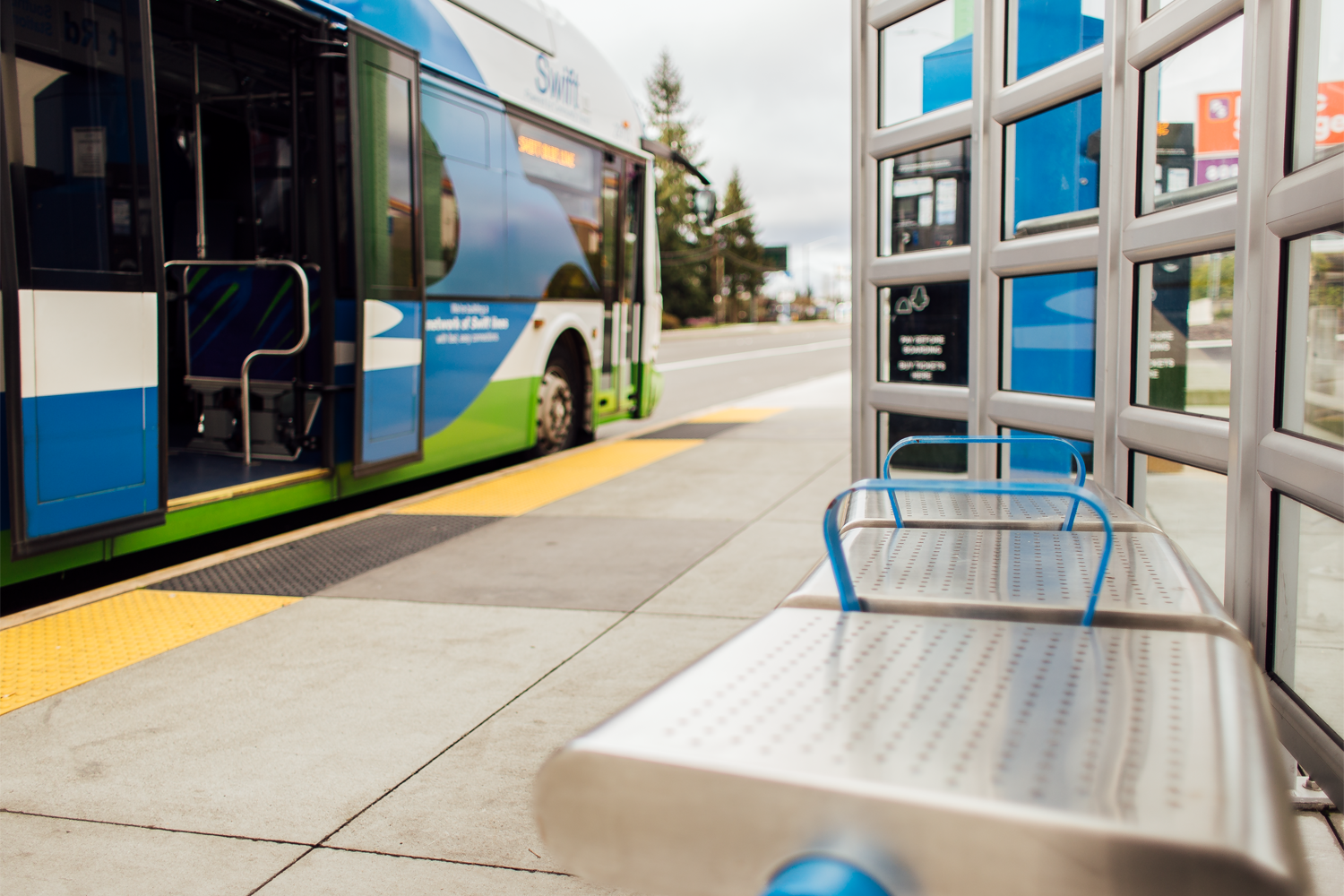
  • Accessibility – Most station platforms are just a few inches shorter than the floor of the bus, making it easy to step aboard. People who use wheelchairs enter at the front door and have an option to use a passive restraint system that doesn’t require coach operator assistance.
  • High tech, high speedORCA smart card readers at each station make paying your fare fast and easy. On some part of the route, buses get signal priority and dedicated lanes to keep them on schedule.

Aurora Village Transit Center 238th St Gateway/216th St Heron/Crossroads ( 200th ) ( 196th St ) Cherry Hill / International ( 176th St ) ( 174th St ) 148th St Airport Rd 112th St 4th Ave Casino Rd Madison St/ Pecks St 50th St 40th St / 41st St Colby Ave / Wetmore Ave Everett Station

How to Ride Swift

Paying Your Fare
How to Buy a Ticket PDF

Each Swift station has two ticket vending machines near the information kiosk. You can use cash, Visa or MasterCard to purchase your Swift ticket. Cash-paying customers should bring exact change, as machines do not make change. Dollar bills need to be carefully fed into the machine at least half way (further than most vending machines). Only one dollar bills are accepted since the machines do not make change.

Tickets are good for one ride on Swift and there are no transfers. The driver does not need to see your ticket, but riders must keep their ticket as proof of payment on Swift.
 

ORCA: The best way to pay for Swift is with an ORCA card. ORCA users simply tap their cards on one of the two ORCA readers at each Swift station to pay their fares before boarding. ORCA users get a two-hour window to take another bus or train while getting credit for the fare they’ve already paid.

Edmonds Community College students, staff and faculty can now get an EdPass/ORCA card for easy riding on all Community Transit buses, including Swift.

ORCA cardholders whose pass value is lower than the Swift fare and who do not have E-purse on their card will need to upgrade their fare at the ticket vending machine using cash or credit card. At Swift stations, ORCA E-purse cannot be used to pay multiple fares.

Swift Ambassadors will be on board Swift buses to randomly check for fare payment and a $124 citation may be written for those who fail to pay. Be prepared to show your ORCA card or Swift ticket upon request. Ambassadors and transit police have the authority to ask for passenger identification (RCW 81.112.210).

Boarding
Swift buses stop at all stations. Be prepared to board or de-board immediately when the bus comes to a complete stop - buses will not be at stations long. Most passengers can board at any of the three doors. Pavement markers indicate where passengers using mobility devices can board at the front door and where passengers with bicycles can board at the rear door.

Once you board the bus, take your seat quickly and grab a hand rail or strap if you choose to stand. The coach operator will not wait for passengers to be seated before leaving the station. Please do not block doorways or aisles.

Swift Stations

Swift stations are located 1 to 2 miles apart, and local bus stops are located nearby for easy transfers. Frequent visits by transit police as well as lighting and regular upkeep help riders feel safe and secure. Each station also has unique artwork.


Click on a station location to learn more about the station name, nearby destinations and connecting bus services. There's also a detailed station map.

1524 N. 200th Street, Shoreline
  • Northbound: Bay 9.
  • Station Map.
  • Connections: Community Transit Routes 101, 118, 130, 131 King County Metro Transit Routes 301, 303, 331, 342, 346, 358, 373.
  • Notes: This station platform is not raised, but the bus can be lowered if needed to reduce the step on board at the front door. Limited parking, restrooms, phone available.
Edmonds
  • Northbound: Station is north of 238th Street.
  • Southbound: Station is south of 238th Street.
  • Station Map.
  • Connections: Community Transit Routes 101, 115, 416.
  • ORCA: Add value to your card at the nearby Safeway store.
Edmonds, Lynnwood
  • Northbound: Gateway Station is north of 216th Street.
  • Southbound: Station is south of 216th Street.
  • Station Map.
  • Connections: Community Transit Routes 101, 110, 119 (at 220th), 405, 871. Other routes connect at the Edmonds Park & Ride, one block west of Hwy. 99 on 72nd Avenue W.
  • Notes: Swedish/Edmonds Hospital and Premera Blue Cross corporate offices are nearby.
Lynnwood
  • Northbound: Heron Station is north of 200th Street.
  • Southbound: Crossroads Station is south of 196th Street.
  • Station Map.
  • Connections: Community Transit Routes 101, 115, 116, 196.
  • ORCA: Add value to your card at the nearby Safeway store.
  • Notes: Edmonds Community College is nearby.
Lynnwood
  • Northbound: Cherry Hill Station is north of 176th Street.
  • Southbound: International Station is at 174th Street.
  • Station Map.
  • Connections: Community Transit Route 101.
  • ORCA: Add value to your card at the nearby QFC store.
Snohomish County
  • Northbound: Station is south of 148th Street.
  • Southbound: Station is south of 148th Street.
  • Station Map.
  • Connections: Community Transit Routes 101, 113, 119, 415, 417, 880, 885.
  • ORCA: Add value to your card at the nearby Safeway store.
Snohomish County
  • Northbound: Station is north of Lincoln Way
  • Southbound: Station is south of Lincoln Way
  • Station Map.
  • Connections: Community Transit Routes 101, 417, 880.
Everett, Snohomish County
  • Northbound: Station is north of Airport Road.
  • Southbound: Station is south of Airport Road.
  • Station Map.
  • Connections: Community Transit Route 101 and Everett Transit.
  • Notes: Home Depot is nearby.
Everett, Snohomish County
  • Northbound: Station is north of 112th Street.
  • Southbound: Station is south of 112th Street. 
  • Station Map.
  • Connections: Everett Transit.
  • Notes: Walmart is nearby.
Everett
  • Northbound: Station is south of Fourth Avenue.
  • Southbound: Station is south of Fourth Avenue.
  • Station Map.
  • Connections: Everett Transit.
Everett
  • Northbound: Station is south of Casino Road.
  • Southbound: Station is south of Casino Road.
  • Station Map.
  • Connections: Everett Transit.
  • Notes: Pedestrian bridge over Hwy 526 connects Casino Road with Beverly Lane west of Evergreen Way.
Everett
  • Northbound: Station is north of Madison.
  • Southbound: Station is south of Pecks Drive. 
  • Station Map.
  • Connections: Everett Transit.
Everett
  • Northbound: Station is north of 50th Street
  • Southbound: Station is south of 50th Street
  • Station Map.
  • Connections: Everett Transit.
  • ORCA: Add value to your card at the nearby QFC store.
Everett
  • Northbound: Station is north of 40th Street
  • Southbound: Station is south of 41st Street
  • Station Map.
  • Connections: Everett Transit.
  • Notes: Northbound station is at Everett Clinic, Gunderson Building.
  • ORCA: Add value to your card at the nearby Safeway store.
Everett
  • Northbound: Station is east of Colby on eastbound Pacific Avenue
  • Southbound: Station is east of Wetmore on westbound Pacific Avenue
  • Station Map.
  • Connections: Everett Transit, Sound Transit Route 510.
  • Notes: Snohomish County Campus and Comcast Arena are nearby
Everett
  • Southbound: Bay G1
  • Station Map.
  • Connections: Community Transit Swift and Routes 201, 202, 270, 275, 277, 280; Everett Transit; Sound Transit Routes 510, 532 and Sounder; Island Transit; Skagit Transit; Amtrak; Greyhound, Northwest Trailways.
  • ORCA: Buy or add value to your card at vending machines near the overhead walkways (on both sides of the train tracks), at the customer service center on the south side of Everett Station and at the vending machine inside the station.
Route
Swift Route Map

Swift serves a 17-mile stretch of the Highway 99/Evergreen Way/Rucker Avenue corridor between Shoreline and Everett.

Both Swift terminals are major transit hubs. At the south end, the Aurora Village Transit Center in Shoreline offers to Community Transit and King County Metro Transit buses that serve south Snohomish County, north King County and downtown Seattle.

At the north end, Everett Station offers connections to Community Transit, Everett Transit, Island Transit, Skagit Transit and Sound Transit buses, as well as Sounder commuter trains, Greyhound and Amtrak.

Local stops near Swift stations offer transfers to additional stops in the corridor as well as east-west service provided by Community Transit and Everett Transit.

Key destinations served by Swift include:

  • Snohomish County Campus - Downtown Everett
  • Everett Clinic – Gunderson Building
  • Edmonds Community College
  • Premera Blue Cross
  • Swedish/Edmonds Hospital

The Swift route has 10 miles of transit signal priority (TSP) intersections, which can extend a green light a few seconds to keep late-running buses on schedule. There are seven miles of transit-only lanes in the corridor, and plans include further traffic improvements.

<i>Swift Vehicle</i>
[+] expand
Vehicles

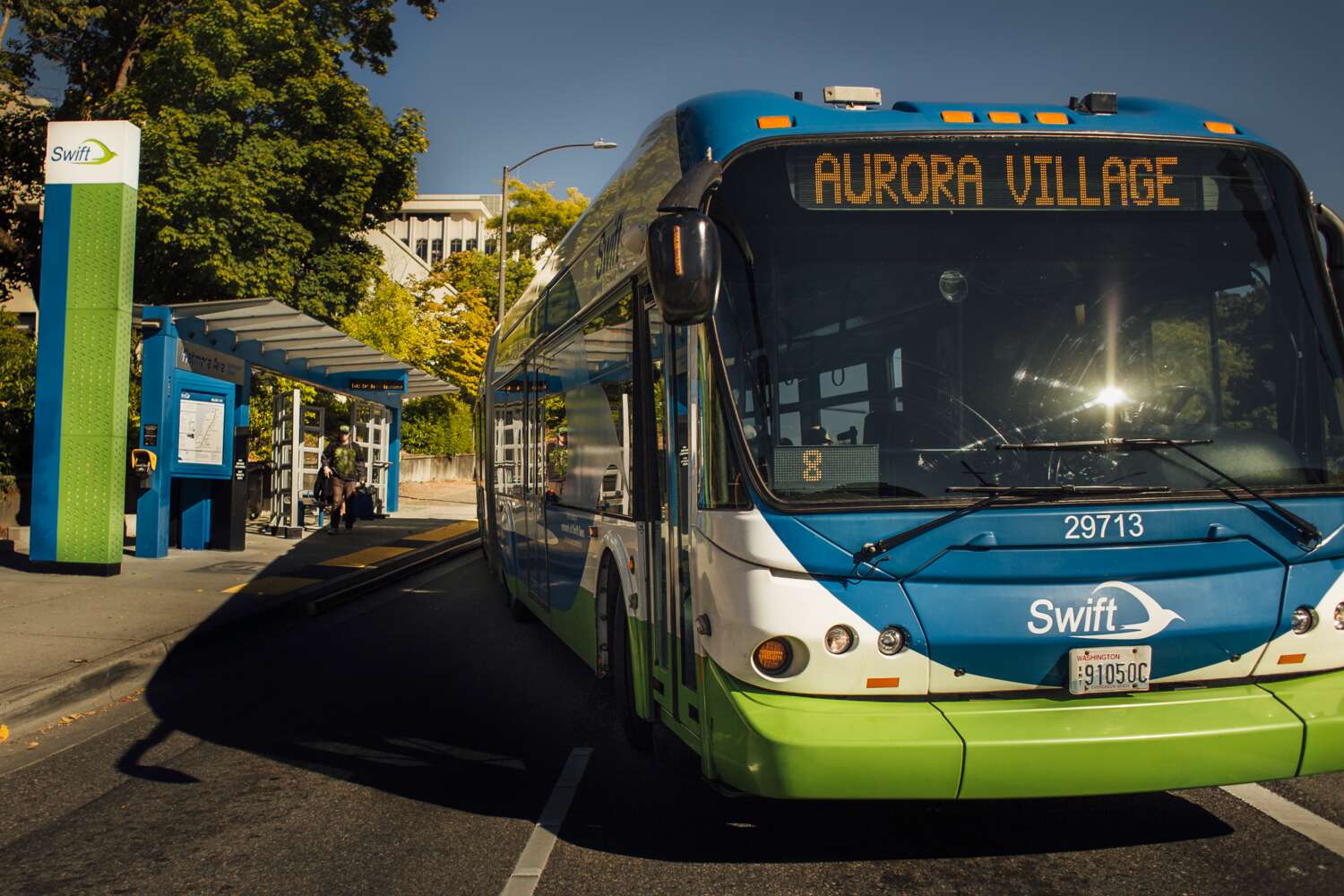
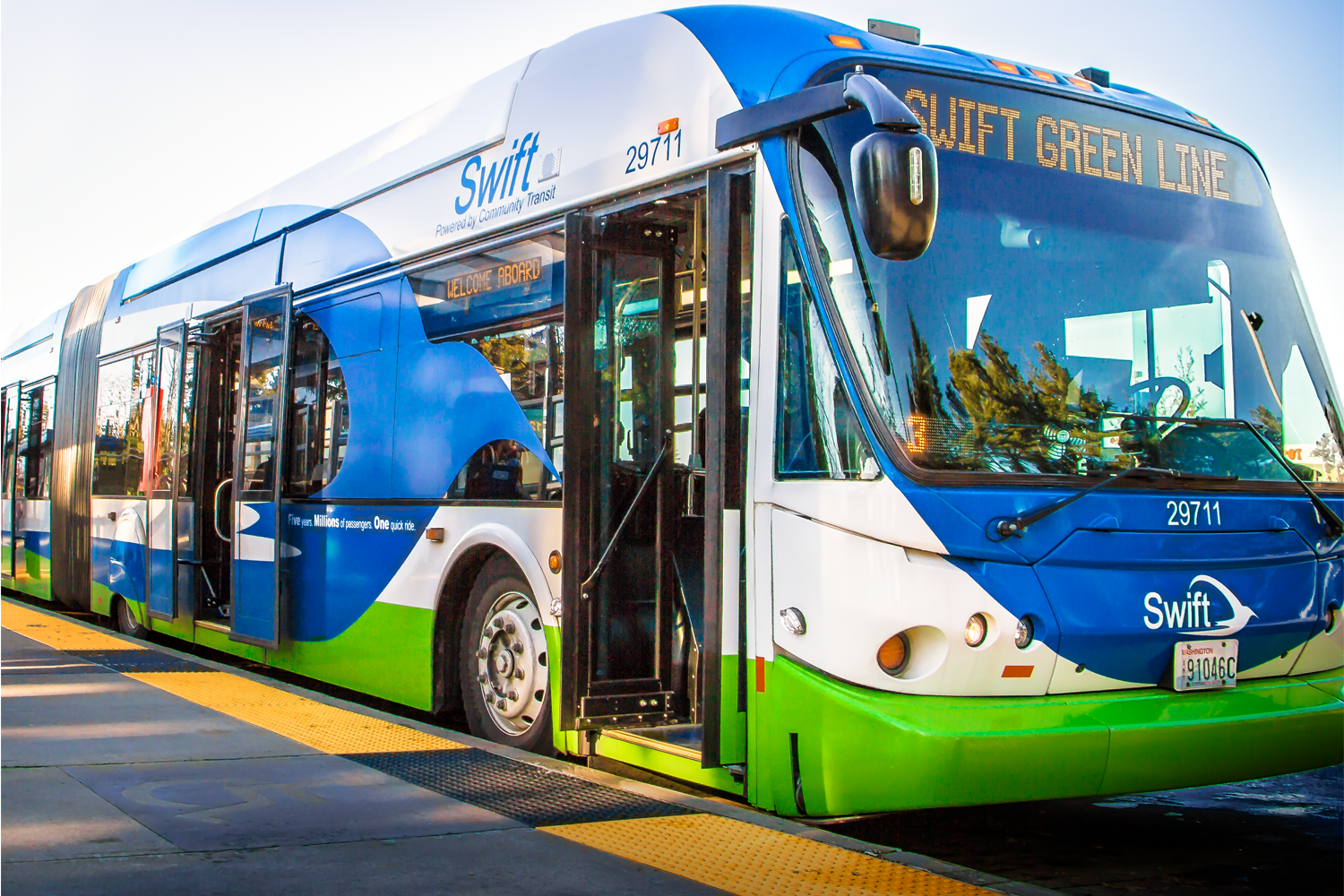
Swift vehicles are stylized 62-foot articulated, hybrid diesel-electric buses with a sleek Swift logo and colorful graphics. The buses are designed with other features you won’t find on a standard bus, including:

  • Three doors for quick boarding.
  • A passive restraint system for wheelchairs that doesn't require coach operator assistance.
  • Onboard bicycle racks custom-designed by Community Transit mechanics.
  • Wide seats with extra legroom for a comfortable ride.
  • Standing room for riders who prefer to stand for shorter trips.
  • Seating for 43 passengers and overall capacity up to 80 riders.

These buses were specially built for Community Transit’s Swift line by New Flyer in St. Cloud, Minn.

Accessibility

Back up to the padded backrest.

Priority for front seats is given to seniors and people with disabilities. Pavement markers on the station platform indicate that passengers using mobility devices should board at the front door, where a ramp can be deployed if needed. Most station platforms are just a few inches shorter than the floor of the bus, making it easy to step aboard  (Aurora Village is the only station without a raised platform).


With wider aisles and no farebox, it’s easy to get onto the bus and into a designated wheelchair position. The two wheelchair bays can either be used in the standard, front-facing position or in a rear-facing position that requires no assistance -- simply back up to the padded backboard, set your brakes and pull down the armrest.

When you approach your station stop, use the call button located in the priority seating area to signal the coach operator that you will be deboarding. The operator can then deploy the ramp or allow extra time at the station as needed.
Bicycles

To load your bike, enter at the rear door and simply push your bike onto the rack in front of you. Make sure that your front wheel is centered and secure under the roller. Fold-up seats are located near the bike racks so you can keep an eye on your bike and be ready to deboard. To remove your bike, pull back firmly.

Racks fit standard bikes with wheels from 20 to 29 inches in diameter and tires up to 3 inches wide. Items that extend to the side or rear may need to be removed to keep the aisle clear and allow other bikes to be loaded.

If the rack is full but the bus is not, the coach operator has discretion to allow you to board and hold your bike securely. However, room for passengers and safety always take priority. If the vehicle is crowded, you may need to wait for the next bus.

Background

Swift Partnerships

Swift is a partnership between Snohomish County’s two local transit agencies: Community Transit and Everett Transit. Thanks to the innovative nature of bus rapid transit, both Community Transit and Everett Transit received competitive state and federal grants to fund most of Swift's capital costs (buses and stations). Everett also contributes operating funds for Swift. This support, plus state and federal grants and fares, pay for 90 percent of Swift's operating costs into 2013.

More on Bus Rapid Transit
Swift News Archive